
How to Search Civil Dockets
Start a Durham docket search at the North Carolina eCourts Portal. Access is free. No account is needed. Smart Search takes a case number or a person's last and first name, and a Durham result opens tabs for Case Info, Assignment, Parties, the chronological Case Summary, Hearings, Dispositions, and Financial information where available.
Need statewide results? Use Advanced Search after Smart Search. Then select Durham under Location. Pick a civil, special-proceedings, or estate category only when the Durham case context fits. One caution: the Portal displays case information, but it is not the everyday filing screen. Attorneys file electronically through North Carolina eCourts File & Serve where it applies, and Guide & File walks self-represented filers through the process. Attorneys use the first; Guide & File serves the rest.
- Enter a full case number when it is known; otherwise enter a specific party name in Smart Search.
- Run the basic search, then set Location to Durham and apply only accurate case-type or status filters.
- Open the matching case number and read Case Info and Assignment to identify the court layer.
- Review the chronological Case Summary, then compare its events with the dedicated Hearings section.
- Contact the Durham Civil or Judgment counter for a paper record, a certified copy, or a record that does not display online.
Durham Civil Docket Portal Filters
Start with the full case number when you have one. On the Portal, that is the sharpest way to pull up a Durham civil docket. A plain name search, by contrast, can spill back 200 matches. Sift through those results instead of concluding the case was never filed.
| Portal field | Use for a Durham civil docket search |
|---|---|
| Record Number or Name | Required starting field for a complete case number or a party-name search. |
| Location | Select Durham to focus a broad result list on the local courts. |
| Search Type | Advanced options can include Case Number, Party Name, and Business Name. |
| Case Search Criteria | Use the relevant Civil Actions, nonconfidential Special Proceedings, or Estates category when accurate. |
| Case status | Useful when known; the public guide does not list each local value. |
What a Civil Docket Shows
Open a Durham case and the Portal labels the running civil record a Case Summary. Its FAQ uses a second name for the same thing: the Register of Actions. Either way, you are looking at a chronological log of activity in the court file, not the file itself. A Durham civil docket can list case information, the assignment, the parties, Case Events, Hearings, Dispositions, Financial information where available, and public documents or judgments when access rules permit.
| Case Info | Basic identifying and classification information reached from the case-number result. |
|---|---|
| Assignment | Court or case-assignment information when the Portal populates that section. |
| Parties | People, organizations, or government roles connected to the matter. |
| Case Summary / Case Events | Chronological recorded activity, including items such as filings, notices, motions, or calendar actions. |
| Hearings | Scheduled court events that should be confirmed through current case-level information. |
| Dispositions | Case-specific resolution or status information, including judgment information where relevant. |
| Documents | Available only if the record is public and display is allowed under the Portal’s rules. |
One caution for Durham cases. Seeing a document event on the docket is not the same as being able to open the document image online. When a public event appears but the image is unavailable there, Durham Clerk staff can get you a copy.
Durham Civil Docket Documents
A Durham Case Summary is useful for confirming that events were recorded: a civil filing, a response, a motion, a notice of hearing, a calendar action, an order, a judgment. That is what it proves. It does not promise a fixed sequence of events for every Durham civil case. Nor does it promise that any given image will open. The Portal offers no Durham-specific document legend, and its entries are not all clickable links to documents.
- Case Event
- A logged event in the case history, not necessarily a public document image.
- Notice of hearing
- A local civil record or form identifying hearing details.
- Calendar request
- A local request to place a matter on a calendar.
- Continuance
- A court-authorized move of a setting, rather than an automatic change.
Types of Civil Cases on the Docket
Search results in the statewide Portal cover much more than civil matters, so the court and case category fields do the routing for you. Durham County fits that pattern. One Clerk of Superior Court handles civil filings alongside family, magistrate, judgment, estate, and special-proceedings work. Where a case lands also depends on the claim type and any specialized law that applies.
- Civil Actions handled through the Superior Court or District Court structure.
- Nonconfidential Special Proceedings and Estates searchable in their applicable Portal category.
- Family Court matters that follow Family Court routing and access limits.
- Small claims and civil magistrate matters within the magistrate jurisdiction.
- Judgment-related civil records handled through the unified Clerk structure.
Durham Civil Docket Court Routes
Money often decides the route. Durham Superior Court takes major civil cases of $25,000 or more. Durham District Court hears civil actions generally between $10,000 and $25,000, while Durham civil magistrates handle small claims up to $10,000, subject to statutory exceptions and procedure. For a docket search, open the Portal first. Check Case Info and Assignment to see which Durham court holds the case, then take your filing or question to that court's counter.
| Civil docket route | Durham channel | Practical use |
|---|---|---|
| Superior Court civil | Civil Clerk, First Floor Room 1500, 919-808-3003 | Case and filing or record questions after the Portal identifies the matter. |
| District Court general civil | Civil Clerk, 919-808-3003; coordinator, 919-808-3018 | Case-level Portal information and current-session scheduling support. |
| Family Court | Sixth Floor Room 6500, 919-808-3075 | Family Court handling under its own procedures and access limits. |
| Small claims / civil magistrate | Third Floor Rooms M1/M2/M3, 919-808-3013 | Small-claims and civil-magistrate path. |
The official North Carolina District Court materials explain the district-level civil docket rules that apply in Durham County.
Don't sort a Durham case by dollar value alone. The court assignment in the Case Summary is the more reliable guide, and a party's own description of the case matters less.
Durham Civil Docket Categories
Not every Durham civil record sits in the same place. Family Court matters run through a separate Durham Clerk channel. Probate and special proceedings stay inside the unified Clerk structure. Pick the matching Portal category first. Then route your Durham docket search to the local office that actually handles it. Small claims work differently again. A Durham small-claims case follows a civil-magistrate path. Its calendar rules do not swap with other civil dockets.
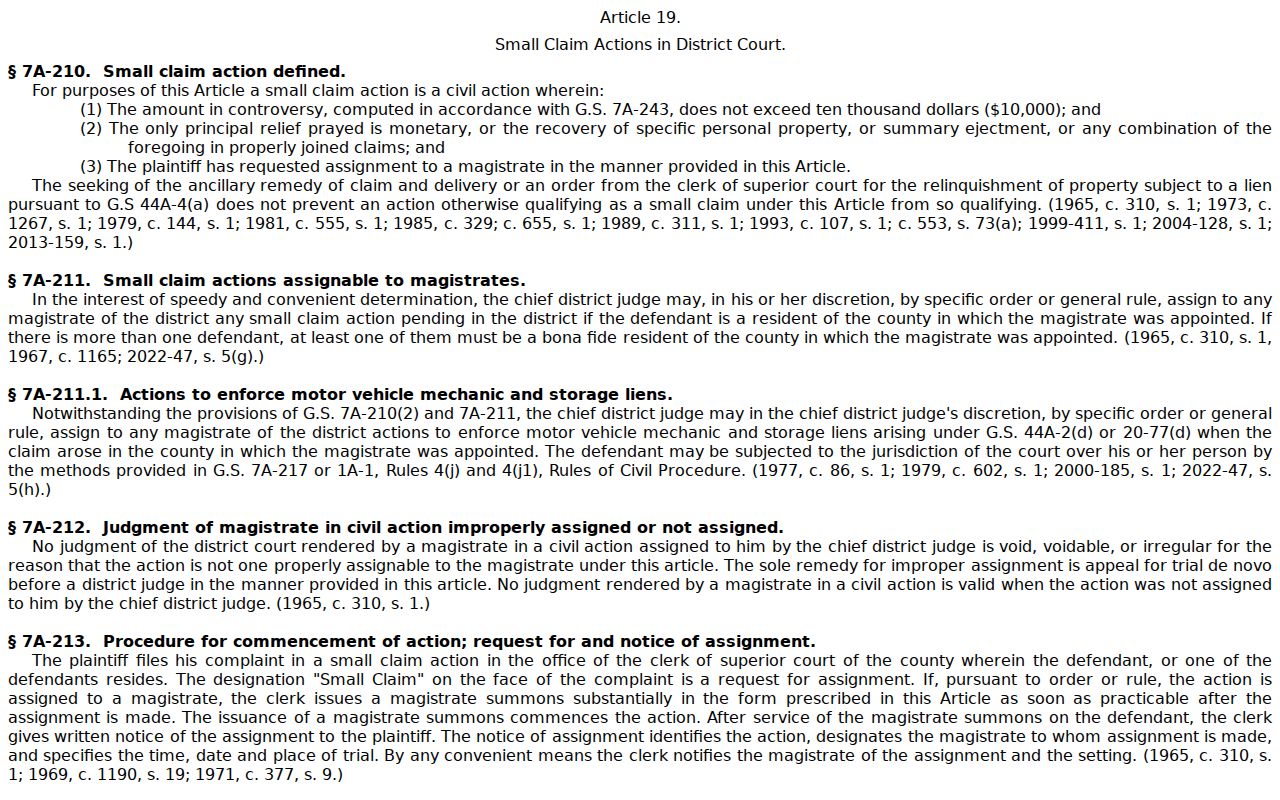
For the authoritative magistrate-jurisdiction statute, see the General Assembly's text. It governs this Durham civil docket image.
Once your docket search returns a case, confirm the records channel before you go further. The court assignment tells you which track applies in Durham. Then use the Civil, Family Court, or magistrate contact for that specific case.
Settings and Hearings on Civil Dockets
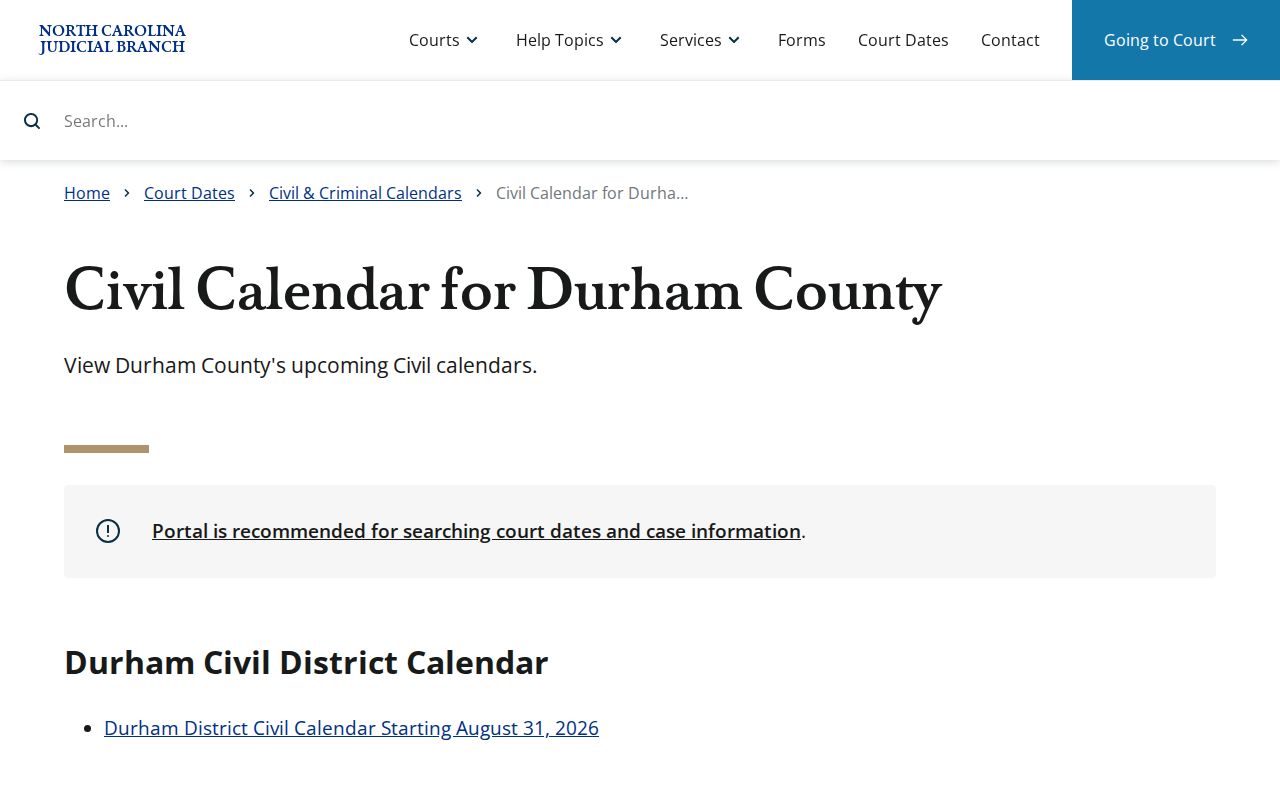
Two views of the same Durham civil docket exist. The Portal's case view is built around one case, so its Case Summary and Hearings sections fit when you already know the case. The Judicial Branch's Civil Calendars service flips that around. It is session-centered, with County and Calendar Type selectors, and it may carry Durham District Civil Calendar and Durham Superior Civil Calendar listings. Party names and case numbers will not work there. The Civil Calendars interface is also the official source for this Durham civil docket image.
Durham settings can shift after the calendar goes out. Check the latest Portal hearing information, then compare it against the current calendar. Still unclear? The District Court coordinator handles current-calendar questions at 919-808-3018. The Civil counter answers at 919-808-3003.
Durham Civil Docket Calendar Timing
Why does a Durham civil setting shift so often? Durham's general civil rules give the answer. The district court coordinator in Durham builds the calendar, and it is never frozen. Trial and administrative calendars typically come together about four weeks ahead, while motion calendars appear roughly one week ahead. Even then, Durham calendars stay open to weekly change.
Say you found your case on an old notice. That paper will not save you. Anyone still listed on the Durham calendar at 4:00 p.m. two business days before court is expected to appear unless the case is properly removed. Before you rely on any setting, confirm it through the current Portal hearing record for Durham, the online calendar, or the coordinator. That three-step chain is the practical way to trust a date.
Durham Civil Docket Calendar Forms
Durham calendar moves run on forms, not favors. The local rules index points to DUR-CIV-3 General Civil Calendar Request and DUR-CIV-4 Notice of Hearing. DUR-CIV-5 covers a motion or order to continue. DUR-CIV-6 covers an objection. Each form makes one part of the process official, and every request needs date coordination first. Requests must reach the court at least ten business days before the general civil session. Proof of notice is due by 4:00 p.m. three business days before the hearing.
These deadlines are civil-calendar mechanics only. They do not govern every criminal, family, or traffic setting in Durham. A Durham Case Summary may show a calendar request or notice of hearing. It may not show the latest operative setting. So check the actual court record before assuming any date.
Public Access to Civil Dockets
North Carolina court records kept in Durham are public within defined limits. G.S. 7A-109 puts the Clerk in charge of records, files, dockets, and indexes. It opens them for public inspection during regular office hours unless a law blocks access. The state Public Records Law supplies broader background. Still, court-specific access rules apply. So do confidentiality statutes. Together they control what the Portal and the Clerk can actually show you in Durham.
Online, the Portal's Durham public view offers both an anonymous path and a registered-account path. Sealed, confidential, and sensitive documents stay off limits either way. A paper file, an older record, a certified copy, or a record that will not appear online calls for the Durham Clerk counter. Its public-access terminal matters most there. When a Durham docket search comes up empty, spelling and format are often the reason. A historical, restricted, or simply nonexistent case can also explain the miss.
Key rules:
G.S. 7A-109 covers Clerk-held court records, files, dockets, indexes, and public inspection unless access is prohibited.
G.S. 132-1 defines public records generally and does not displace court-specific access limits.
G.S. 7B-3000 keeps juvenile court records confidential except as statute or court order allows.
Durham Civil Docket Dispositions
Before calling a Durham civil matter finished, read the Dispositions and judgment data. A judgment index is not a final word on its own. Terms like default judgment, voluntary dismissal, or dismissal for want of prosecution carry specific meanings. Use them only when the individual Durham Case Summary backs them up. A published local source works too. Guessing at labels invites error. A case event is not the same thing as a final outcome.
Money needs the same caution. The Portal guide for Durham describes a judgment amount as the amount at entry. That is not a current payoff figure. If current information exists, it lives in the fuller Smart Search case context.
Note: For a case-specific Clerk question, start with the exact disposition label. It is shown in the current Durham Case Summary.
Durham Civil Dockets After eCourts
Durham moved onto eCourts in Track 4, with the conversion scheduled for April 29, 2024. The Judicial Branch said the legacy system would become inquiry-only during the shift. In its place, the Portal would take over legacy public applications in Durham. These cover court indexes, abstracted information, and documents. That is why the Portal is now the main online route. Paper and historical documentation remains a Clerk-office resource.
Kiosks came next. In 2025, the Branch announced public eCourts kiosks for Durham and other courthouses, adding Portal access, Guide & File and File & Serve, scanning, printing, case-event and court-date access, and payment services. The notice gives no exact local kiosk room. Take any current Durham access question to the Clerk.